


GM,
Binance is one of the most recognized names in Web3, and the company is on a hot streak right now. Its former CEO got a US government pardon, its cryptocurrency token recently hit new highs and its business is producing exciting new services at the forefront of the industry.
Binance may be in the best shape since its launch in 2017. Let’s dig into the details.
Best,
What’s going on?
Binance is on a tear this year. It’s not news to say that this is one of the most important and influential businesses in Web3, but Binance has bounced back successfully after a challenging last year set its business back significantly.
During the Biden administration, the company ran into trouble which included:
November 2023: Binance paid a $4.3 billion fine to settle federal criminal charges for sanctions violations that included running unlicensed money transmitter business and failing to maintain an adequate anti-money laundering (AML) program
That settlement saw former CEO Changpeng Zhao “CZ” step down and pay a $50 million fine
Richard Teng, a veteran compliance executive whose past roles included Chief Regulatory Officer at the Singapore Exchange (SGX), became the new CEO
April 2024: CZ was sentenced to four months in prison after pleading guilty to violating US money-laundering laws
This year, however, CZ was pardoned by the Trump administration and Binance’s BNB token surged to an all-time-high in October, doubling its value over 12 months.
Plenty has happened within the industry and the company itself to facilitate this resurgence.
SO WHAT?
1. Controversial pardon gives CZ new Binance role
CZ is the public face of Binance, and that’s been the case since the business launched almost a decade ago. It was inevitable, then, that when US regulators came for Binance, he would also pay a price.
The multiple blows of a huge $4.3 billion fine and CZ’s imprisonment hit Binance hard, and the company’s reputation was hit hard by both those outside of Web3 and the traders who use its services.
CZ’s replacement Teng was ideally suited to the task of rebuilding the then-struggling company’s business. Binance needed to plot a new course as a regulator-friendly crypto company, and that 180-degree switch gained credence with Teng at the helm. But that, in turn, was seen as a negative for many in the Web3 space who distrusted governments and regulators, the very groups Binance now needed to be cozier with.
Teng may run Binance, but CZ’s strong presence online—which includes over 10 million Twitter followers and nearly half a million more on Instagram—has seen him become a vocal advocate and unofficial spokesperson for the company.
President Trump’s decision to pardon CZ in October 2025 is controversial given the overlap between Trump’s business interests in the Web3 space—which are said to have generated more than $1 billion for his family—and Binance itself.
Trump’s World Liberty Financial (WLF) stablecoin business held talks about developing products with Binance
WLF deployed its stablecoin on Binance’s chain
The WLF stablecoin was used directly to facilitate a $2 billion investment in Binance from an Abu Dhabi state-backed company
Binance and CZ denied the conflict, and Trump himself has denied knowing CZ.
Despite the optics, the pardon gives CZ newfound legitimacy that Binance is using to shape its strategy.
CZ was front and centre when the country of Kazakhstan announced the launch of a national stablecoin and a central bank digital currency in partnership with Binance. The stablecoin will be on Binance’s BNB chain, cementing a long-standing partnership with Binance. CZ is an official advisor to the government, and Binance signed an MoU with Kazakhstan in 2022.
These are the types of moonshot projects that CZ would spearhead more readily following the US government pardon. His fingerprints certainly appear to be across other parts of Binance’s strategy, with Teng handling the core business.
There’s also plenty of self interest for the former Binance CEO.
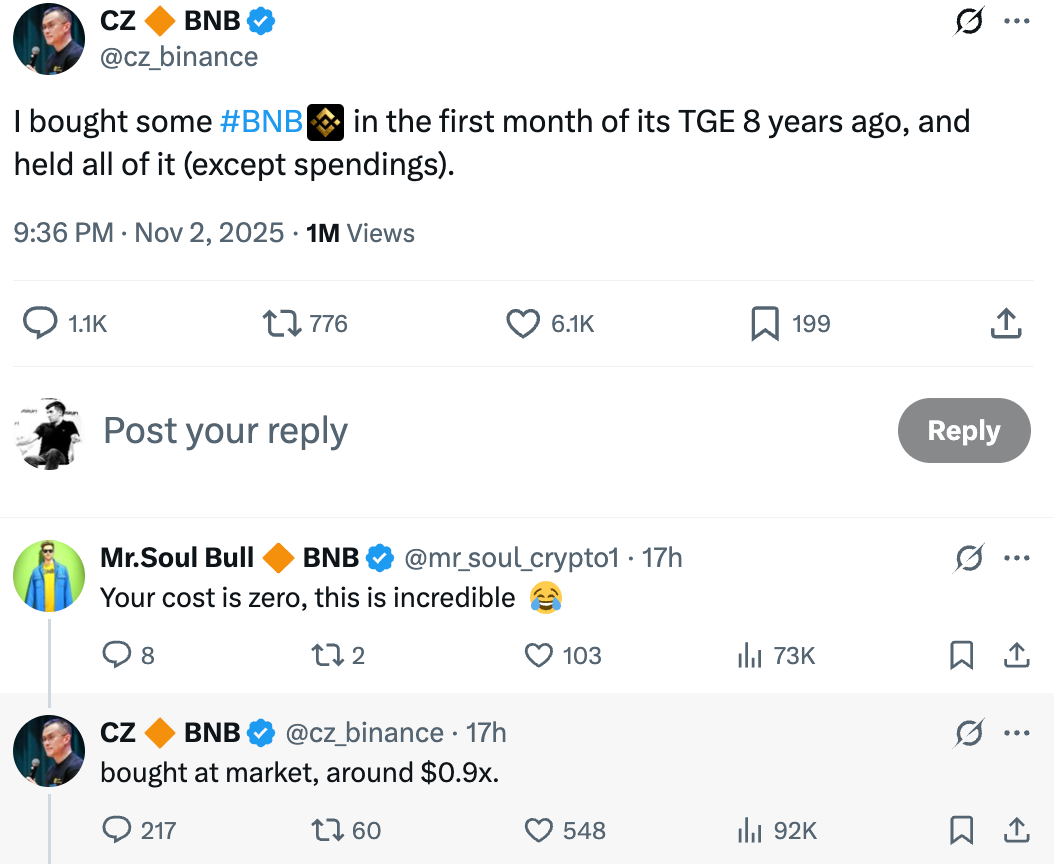
CZ has never disclosed his full crypto holdings, but he is known to own Bitcoin and BNB. He did not confirm his holdings, but did say on Twitter that he acquired BNB for less than $1. Today, it trades at over $1,020.
2. Doubling down on its blockchain and ecosystem
In the world of Web3, building a business isn’t simply about revenue and profitability for your core units. Companies launch and develop tokens and blockchains, which can succeed through very different goals and milestones.
Binance’s BNB is a layer-one blockchain, which means it can host trading exchanges, games, wallets, and other services directly.
BNB is directly comparable to Solana for the fact that it is rivaled by Ethereum, a chain that is heralded and used by many long-time cryptocurrency enthusiasts and academics. BNB is by far the best-performing and most adopted blockchain from a crypto exchange, most of which have very limited utility and activity from developers.
It may not be widely-acclaimed but fees and revenue from apps on the BNB chain generate an estimated $1.5 million per day for Binance, according to data from DeFi Llama. That puts BNB in the top 10, behind the likes of Solana, Ethereum, Hyperliquid (which we’ve written about) and others.
Solana has enjoyed an impressive recovery over the last two years, having been dragged down by the bankruptcy of key advocate FTX. We explained in past issues how Solana zeroed in on working with developers and hosting the most promising new Web3 services, which includes memecoin launchpads like Pump.fun and prediction markets.
Binance has taken a leaf out of Solana’s playbook, and tapped into emerging Web3 trends to develop Binance owned and affiliate services that it hopes will add value to BNB. The price of BNB reached an all-time-high in October suggesting that the narrative, at least, is working.
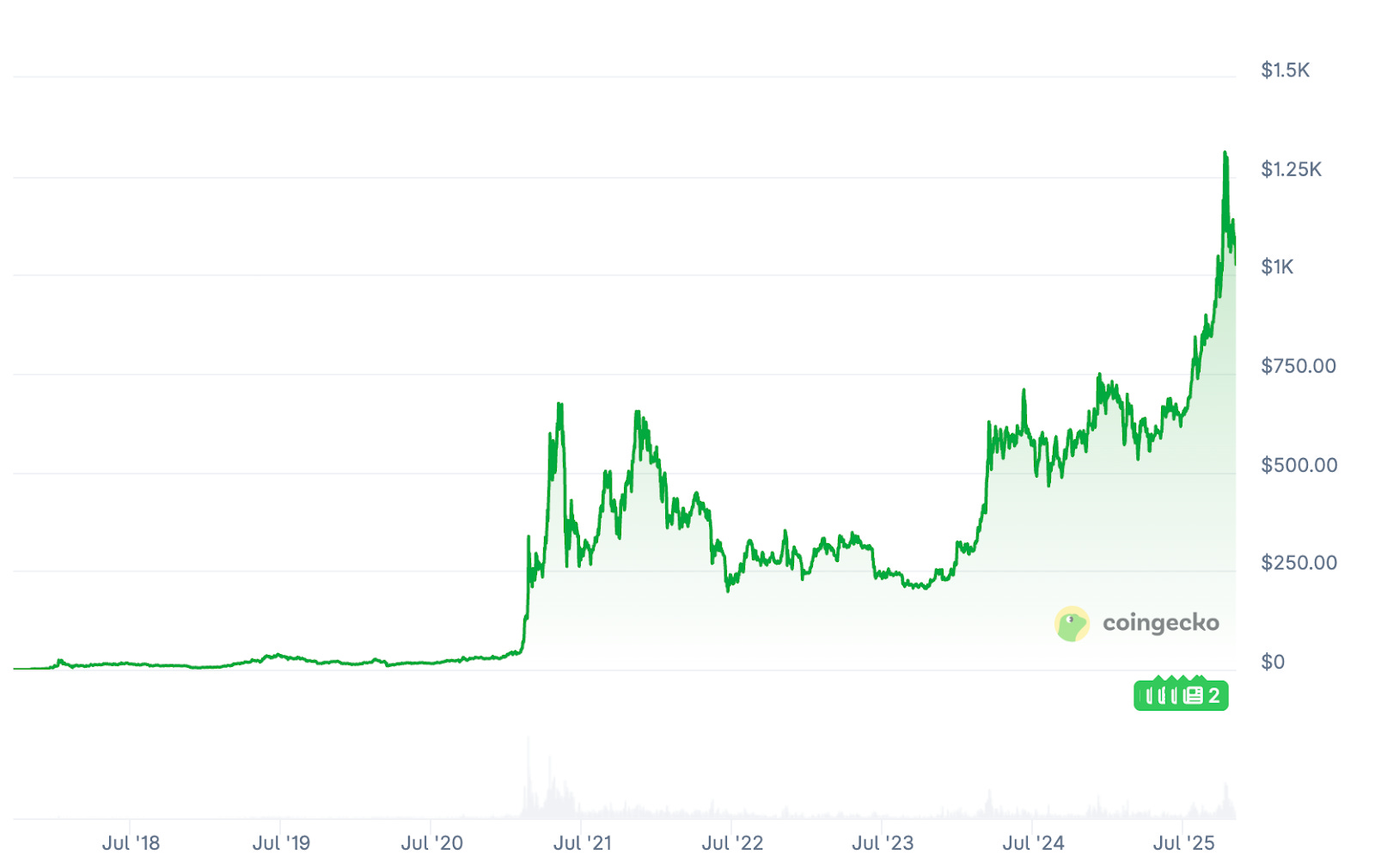
Data via CoinGecko
Inside Tether, the insanely profitable stablecoin firm that’s Web3’s backbone

GM, This week is the first of a three-part series of Tether, the company behind USDT—the world’s most traded stablecoin—which has grown into a multi-billion dollar business that holds more US bonds than many countries, and is charging into AI and other areas.
3. Aggressively building beyond its ecosystem by following hot topics
CZ appears to have been firmly involved in aggressively developing the BNB ecosystem and associated services.
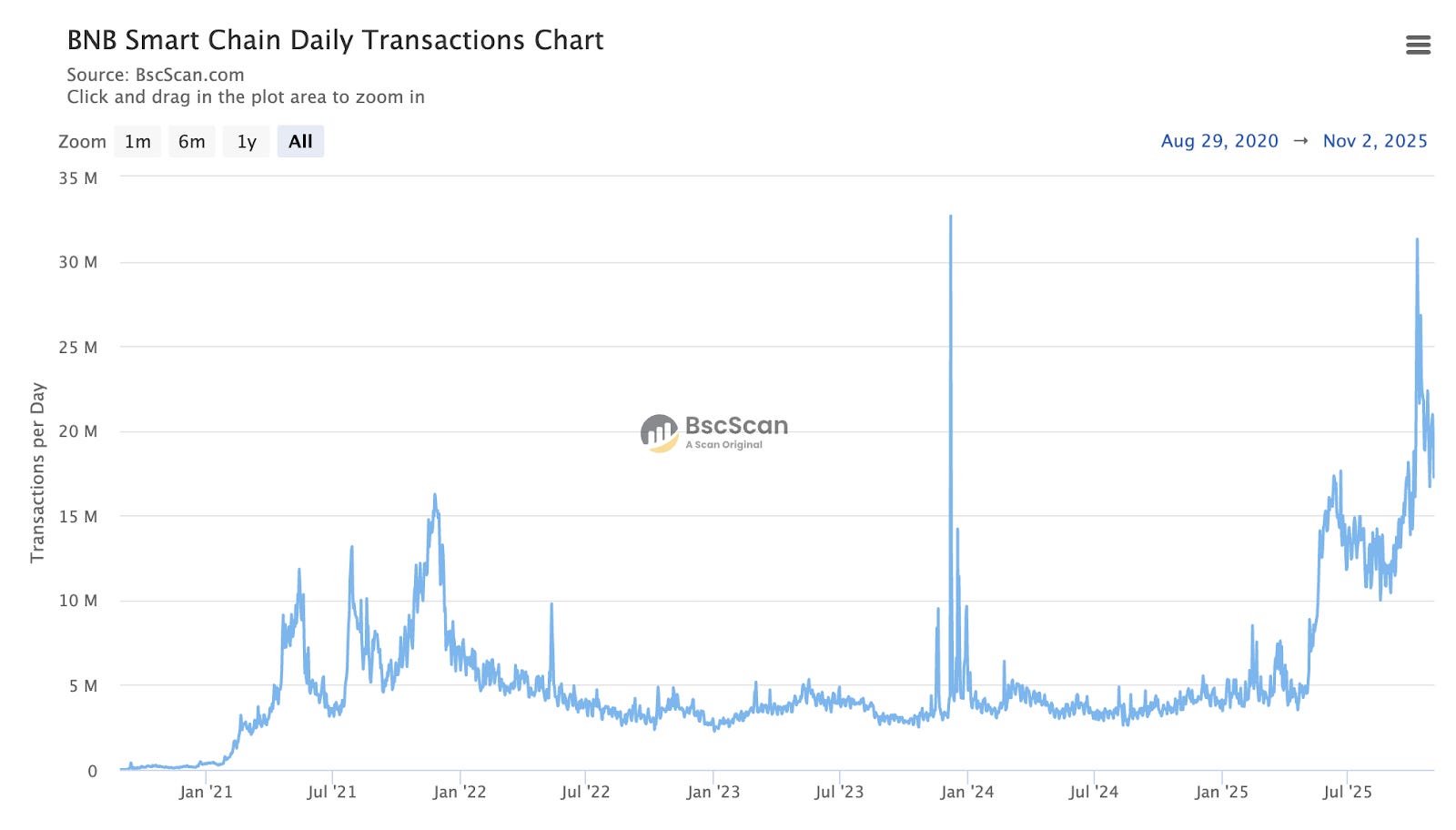
There’s a clear increase in transactions on the chain from May 2025, when BNB launchpads for memecoins caught attention. CZ himself even became part of the movement as tweets about his cat and other topics became memecoins that surged in value, generating significant transaction volume and fees.
Memecoins generate plenty of attention and action, but the BNB ecosystem expanded in other meaningful ways this year.
BNB got its own version of Hyperliquid, the decentralized perpetual trading service that’s boomed into a serious revenue-generating product.
We previously wrote about Binance’s concern at Hyperliquid’s rise, which had taken a slice out of Binance’s own market share with traders looking for less centralized marketplaces. Binance wasn’t able to stop Hyperliquid, so it introduced its own answer to it: Aster.
Founded by former Binance employees, backed by investment from Binance’s YZi Labs fund and living on the BNB chain, Aster is Binance’s Hyperliquid.
Aster launched its token in September 2025 and, as the chart above shows, that boosted awareness of the service and sent the number of transactions on the BNB chain soaring further still. Aster’s ascent continued this week as the price jumped by 30% after CZ disclosed he had acquired the project’s token.
CZ and Binance are not done there though. He went to X, as he often does, to put out a call for a prediction-market oracle on BNB which could allow prediction markets on the BNB chain, and perhaps within Binance’s own business units.
That makes sense considering the explosive growth that market leaders Kalshi, Polymarket and others are seeing.
Kalshi recently raised $300 million at a valuation of $5 billion, which reports suggest could soon jump to at least $10 billion for its next funding round. Polymarket just raised $2 billion from Intercontinental Exchange (ICE), owner of the New York Stock Exchange, at an $8 billion valuation. Reports claim that it could reach as much as $15 billion with its next funding round.
With BNB already an established chain for liquidity, trading and other activity, developing quality prediction markets is entirely logical.
Aggressively growing the BNB ecosystem seems like an ideal pursuit for CZ, and you would expect to see him push further especially now that he has been pardoned.
News bytes
Animoca Brands, a high profile Web3 firm best known for investing, gaming and metaverse, filed for a Nasdaq listing via a reverse Singapore’s Currenc Group—it is targeting a $1 billion valuation
DeFi project Balancer appears to have lost $71 million following an exploit
Latin America-based crypto exchange Ripio, which has 25 million registered users, launched a stablecoin that’s pegged to the Argentine peso
Malaysia’s central bank launched a three year exploration of real world asset tokenization, potential use cases range from supply chain finance to Islamic finance products
Coinbase is reportedly in late-stage talks to acquire stablecoin infrastructure startup BVNK in a deal valued at around $2 billion
That would represent another major acquisition in recent times after Coinbase acquired Web3 investment platform Echo for $375 million in October
That’s all for this week!
Share your feedback, questions or requests via email to: sowhat@terminal3.io