


GM,
Can you imagine Amazon Bucks? Google Dollar? Apple Coin?
The possibility of the world’s top tech companies issuing their own digital dollars just got a lot closer after President Trump signed the GENIUS Act: that’s short for Guiding and Establishing National Innovation for US Stablecoins.
The act is the first piece of US regulation for stablecoins—crypto tokens backed by the US dollar—and it opens a whole host of opportunities for Web3 native companies and, most crucially, for new entrants to jump in.
In this issue of SO WHAT, we break down the details to get you fully up to speed.
Best,
Gary and Jon
What’s going on?
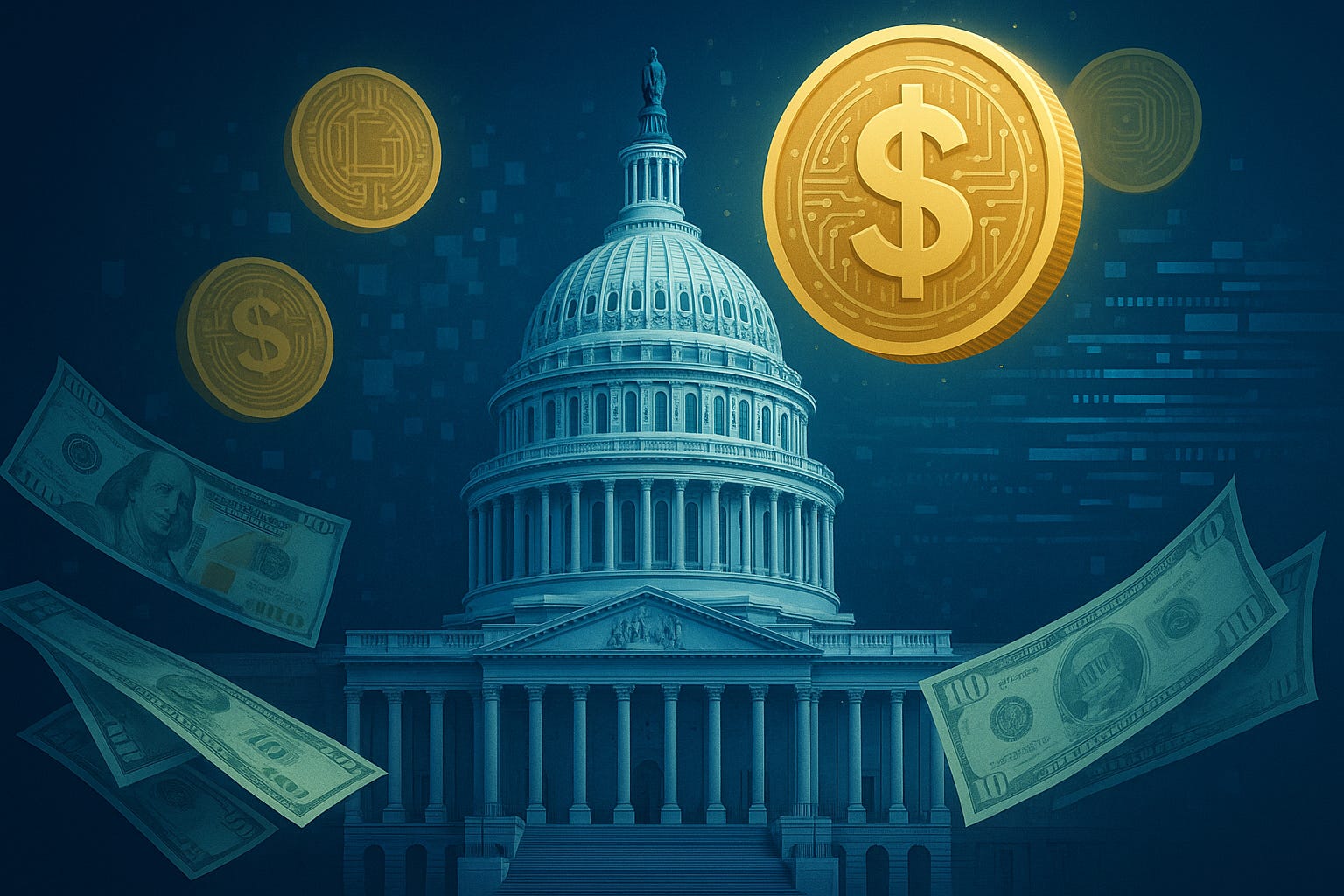
President Trump wants to make the US the “crypto capital of the world,” and he has certainly done more for the industry than any other administration after just six months in office.
Trump established a Strategic Bitcoin Reserve and a US Digital Asset Stockpile and now the GENIUS Act lays the foundations for digital assets to become part of the mainstream financial system. It’s all part of a strategy to regulate crypto, a major shift from previous White House offices which have aggressively gone after the nascent industry.
The GENIUS Act’s passing means Amazon, Google and even Apple are among those researching the feasibility of issuing their own stablecoins now that there is a regulatory framework, as we’ve explained in past issues. That could help them move money globally, boost user engagement and much more.
The Act doesn’t answer everything, though. Questions remain on areas like accounting. We can expect further legislation to address those topics, but already the US impact is being felt.
Asian countries are pushing the envelope for digital assets, but they’re inspired by the US. South Korea is expediting its newest stablecoin regulation and countless other governments worldwide will be paying close attention.
SO WHAT?
1. A light touch for stablecoin issuers
The Act provides clarity to the grey area of stablecoins through a federal regulatory framework.
The requirements are light, but largely as you’d expect:
Companies that are approved to issue US stablecoins must show that their digital token is backed by US treasury bills (T-bills) bonds, or US dollars themselves at a minimum 1:1 ratio and held in a segregated account.
Issuers are subject to the US Bank Secrecy Act, which requires them to adhere to anti-money laundering and sanctions compliance standards. They must also be able to freeze, seize or burn their tokens.
Issuers provide a monthly report to confirm the composition of their reserves, with sign-off from an accounting firm.
They have a choice of state or federal regulation unless the total FDV (fully diluted valuation) of their stablecoin surpasses $10 billion, in which case it must be the latter.
There’s been concern that issuers aren’t subject to the same rigorous protections as banks. Corey Frayer, director of Investor Protection for the Consumer Federation of America, told CNBC that a stampede of stablecoin issuers could be ripe for “another financial crisis.”
The Act prioritizes stablecoin holders in the event of a bankruptcy, but Frayer argues issuers are still being asked to essentially police themselves
Risk is high with most digital assets, as we’re constantly reminded with slogans such as ‘don’t invest what you can’t afford to lose.’ Stablecoins may be backed by fiat assets—the clue is in the name—but they could still be volatile, even with the GENIUS act.
Stablecoins won’t be allowed to pay interest, aren’t backed by the federal government, don’t fall under deposit insurance and don’t come with consumer protections, Frayer warned.
2. Finally, definition for digital asset companies
But wait, there is more. GENIUS was accompanied by CLARITY, the Digital Asset Market Clarity Act, which sets out how digital assets should be governed in the US.
It categorizes digital asset companies and lays out the division of power between the Commodity Futures Trading Commission (CFTC) and Securities and Exchange Commission (SEC).
The CFTC is responsible for regulating digital commodities—that is defined as digital assets that are decentralized and do not include a right to profits, such as Ethereum or Bitcoin.
Digital assets that represent investment contracts, such as early-stage funding, are restricted digital assets that fall under SEC jurisdiction.
There’s an important clause that allows blockchain companies to raise up to $75 million per year without triggering securities laws if they meet specific criteria, which include providing source code, details of governance and token functionality.
This law is potentially equally transformative. It gives a baseline for Web3 companies to finally base themselves in the US with regulatory clarity.
Previously, companies have lamented the uncertainty of being a Web3 company that’s based in the US. Even Coinbase, the largest Web3 native company in terms of impact, valuation and more, considered relocating a large part (or even all) of its business overseas. Such was the aggressive way that the previous administration went after companies.
It isn’t all roses, though. Critics have claimed that the law will weaken the SEC’s role of protecting retail consumers from the volatile nature of the Web3 industry and related investment opportunities.
It remains to be seen how the law will play out in reality, but the controversy has already begun.

3. Trump’s own interests loom large
The two acts (which are coupled by a third piece of legislation outlawing a US central bank digital currency) provide welcome ground for both Web3 native companies and existing businesses venturing into Web3, but there is the issue of self-interest for President Trump.
Trump and his family have already profited significantly from cryptocurrencies:
The President’s shares in World Liberty Finance, his family’s blockchain business which are listed on the Nasdaq, are worth around $2 billion
A disclosure filed last month suggested he made over $57 million from selling World Liberty Finance tokens ($WLFI)—those he hasn’t sold could be worth over $1 billion, according to Forbes
Members of Trump’s family have acquired major cryptocurrencies, such as Bitcoin, while his policies have arguably influenced prices, for example the Strategic Bitcoin Reserve
Then there’s the Trump memecoin, which is harder to value but did gross $100 million in trading fees as far back in January
These ventures will directly benefit from these new laws.
Notably, Trump’s memecoin won’t violate securities laws, The World Liberty Finance stablecoin will have a framework to exist within and any other blockchain businesses from Trump stand to benefit, too.
With an estimated 50% of the Trump wealth now tied to Web3-related ventures, it is hard to avoid the self interest.
Despite that, there’s been significant movement.
Tether—which issues the largest stablecoin on the planet, USDT—has already said it plans to launch a US-version of its token in response to the passing of the GENIUS Act. Ethena, another stablecoin issuer, has partnered with US bank Anchorage Digital for a US launch and Polymarket—the predictions market we previously wrote about—is reportedly planning a stablecoin.
These laws are sure to have an almost immediate impact.
The GENIUS and CLARITY Acts represent a pivotal shift in how the US approaches digital assets. The move is from enforcement-first chaos to a framework that encourages innovation, clarity, and competition. For the first time, global tech giants, traditional financial firms, and crypto-native companies have a regulatory runway to build—and potentially reshape—the future of money.
But big questions remain. How will businesses outside of Web3 adapt to this new framework? Will additional laws close the remaining gaps, especially around accounting and consumer protection? And can a president with deep personal stakes in the crypto space fairly oversee its growth?
Regardless, the US has thrown down the gauntlet. With Tether already responding and other countries watching closely, this could be the moment the race to digitize finance truly takes off.

News bytes
Western Union is exploring ways to offer on-ramp and off-ramp stablecoin services, according to its CEO
Centralized exchange Woo X was hacked for more than $12 million
Ghana is set to become the latest country to regulate crypto firms as digital assets
Tether confirmed it worked with US authorities to freeze around $1.6 million in USDT that allegedly used used for terrorist financing in Gaza
JPMorgan has downgraded its estimate that the stablecoin market could reach $2 trillion by 2028 due to underdeveloped infrastructure—but it still forecasts the market tripling from $260 billion right now
That’s all for this week!
Share your feedback, questions or requests via email to: sowhat@terminal3.io