


GM,
AI prompts are a core part of today’s internet experience as the world is increasingly attached to a personal assistant in their pocket.
But this is just the first iteration of what artificial intelligence promises. In the coming years, we can expect AI to handle our payments, travel bookings and much more as AI agents are equipped with digital currency and the ability to engage with each other.
There’s one crucial element, however, privacy, as we dive into details in this week’s newsletter.
Best,
Gary and Jon
PS: You can read more on this topic in our newest report
What’s going on?
We’re at an inflection point in how people interact with the internet. The shift from browsing and typing to chatting with AI means we’re not just searching anymore, we are sharing.
People are sharing relationship challenges, fitness goals, career aspirations and more. For companies, it can be more serious. Code bases, business development plans and planned announcements are among the sensitive details to have been inputted into AI chat conversations.
Every prompt reveals something about us. What we value, how we think and what we plan to do next.
AI feels private based on the conversational window we use to interact and the nature of chats, but it often is not.
Prompts can be logged. They are used for model training or, at times, even leak through connected systems.
Privacy is already a huge issue, but it is about to get even more serious. AI will be the nucleus of the agentic web, systems that will enable AIs to interact, collaborate and act autonomously.
Privacy will no longer be an option, it will be essential.
SO WHAT?
1. AI prompts are a huge data leak waiting to happen
Google is still the search king, but even it has been forced to incorporate AI-generated results right below its search bar such is the ubiquity of using AI to find answers.
Once, we typed into a search engine. Now, people are increasingly not even going there. AI is direct, easy and in your pocket and it gives you answers in spite of typos, response accuracy and more.
There are major differences between using Google and ChatGPT, Claude, Gemini or others. Principally, it collects far more concentrated data which is inherently more personal.
The conversational interface of AIs makes people overshare.
It feels like chatting to a friend or a knowledgeable colleague. That may be a reason why people open up and tell their AI chatbot the type of information that’s very personal. That could be financial worries, relationship issues, product roadmaps, or code snippets.
They feel like personal assistants, but those interactions live on servers controlled by third parties. The data is often used to train AIs to be more efficient and there are examples of information leaking out.
OpenAI confirmed in July 2025 that ChatGPT users now send 2.5 billion prompts every single day. That’s a 150% increase in just eight months. And ChatGPT is just one player in an increasingly crowded field.
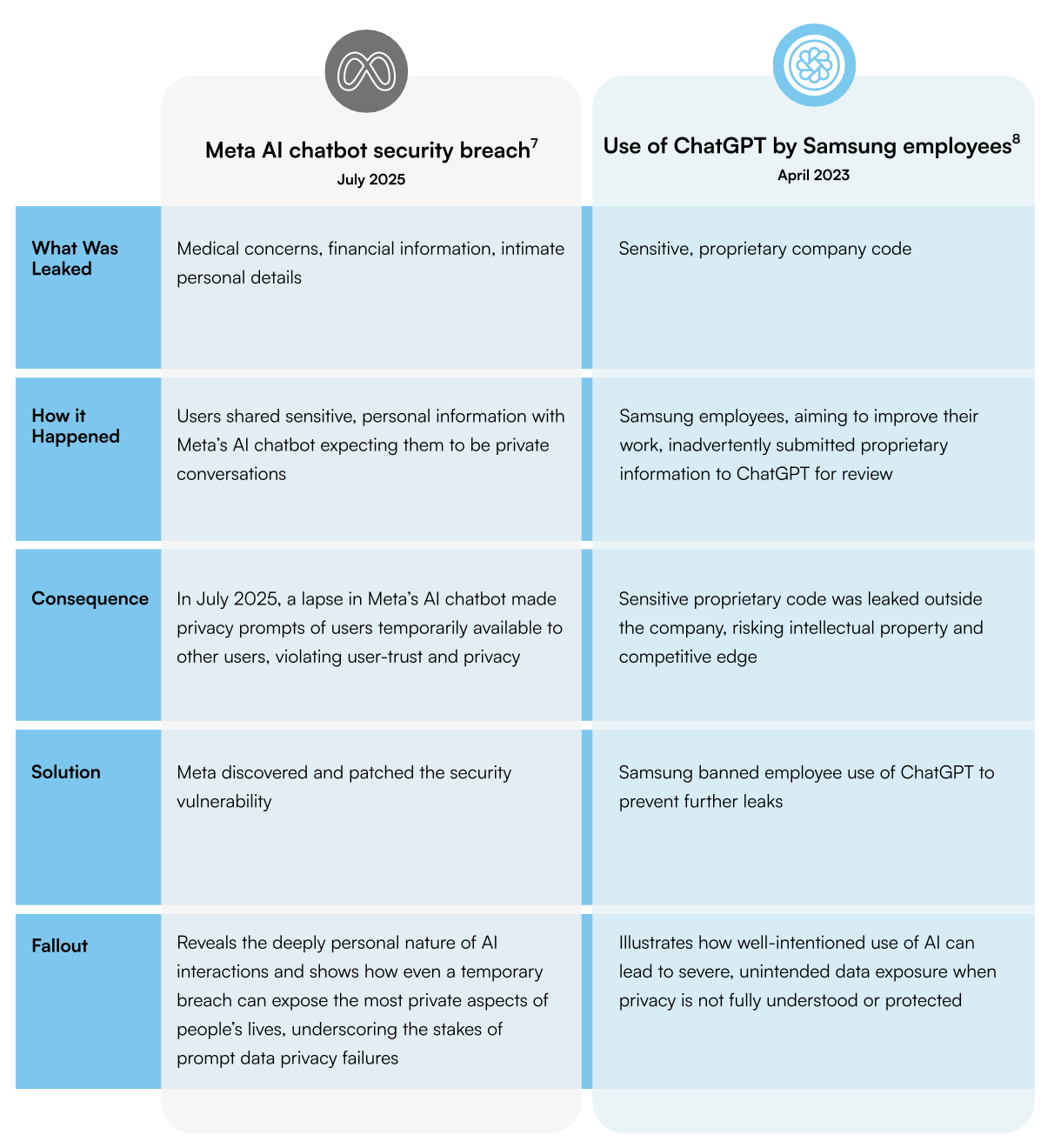
A security breach on Meta’s AI chatbot earlier this year saw information including medical concerns, financial information and other intimate personal details were temporarily made available to other users.
The issue was patched, but it showed how easily such personal details could be exposed.
Then there is general naivety.
Samsung banned the use of ChatGPT and other AI products in 2023 after it found its employees had inputted sensitive company information and proprietary company code into the AI chatbot.
That release of confidential IP showed that even well-intentioned use of AI (Samsung staff were looking to improve their work and increase efficiency) can generate major privacy and security issues. Unsurprisingly, other companies have since followed suit.
For companies, that’s a nightmare scenario. Employees feeding confidential data into models and servers that they don’t control. For individuals, it’s like sending your digital diary straight to Silicon Valley or China, with anyone potentially able to access the data.
The response has been educating users or even banning products, as Samsung did. But, ultimately, prompt privacy must be treated like end-to-end encryption. It should be a baseline expectation, not an afterthought.
2. Digital money increases the stakes massively
AI agents have established themselves as an internet companion or pocket personal assistant, but much more is coming as they evolve into autonomous financial actors.
That’s to say that, beyond drafting emails and asking questions, they will begin helping you handle tasks automatically and that will include spending your money.
Back in May 2025, Web3 giant Coinbase introduced x402, a payment protocol that allows APIs, apps and AI agents to transact seamlessly using stablecoins.
X402 is being used to instruct agents to book flights, manage subscriptions, send tweets and do other activities that a person would typically handle. Stablecoins in a crypto wallet are used for transactions.
This concept is being pursued by other companies beyond Coinbase. Cloudflare, which is not a Web3 company, recently announced plans for a US dollar-denominated stablecoin that it says will be used for transactions in the agentic web. So paying for online services and more.
This future of AIs paying for APIs, making purchases, managing subscriptions and transferring funds between wallets without direct human intervention is very real.
We’re heading toward a world where digital assistants can handle invoices, negotiate prices and rebalance investment portfolios. All in real time.
This makes security even more essential.
In the agentic web, prompts become a potential transaction, which means the metadata associated with those actions, such as frequency, timing, amounts and counterparties, forms a detailed financial fingerprint for each user.
That data is important, since it could be used for credit, insurance and other services that may not exist now. But in the wrong hands, those details could be dangerous.
Combined with identity or behavioral data, financial information can expose business strategies, wealth levels, purchasing habits or even future intentions. There’s potential for a malicious actor to model your transactions well enough to predict and impersonate your behavior, even if they don’t have your bank password.
DePIN is Web3’s buzziest topic—and it could be key to the AI revolution

GM, Decentralized physical infrastructure network (DePIN) is one of the buzziest topics in Web3 right now. The concept is to build physical networks that can run without middlemen. File-storage, WiFi, mapping and artificial intelligence are just some of the industries where DePIN is showing the potential to change the game. There’s plenty of hype but can…
3. The agentic web dream risks turning nightmarish
Agents won’t just handle your prompts and money, the roadmap for the agentic web will see agents connect with others to handle tasks that would usually require a middleman.
Coinbase’s X402 and Cloudflare digital dollar are rooted around enabling agent-to-agent activities. Already, we are seeing early pilots that will only become more sophisticated over time.
Here’s how it could play out, as outlined in a recent Terminal 3 whitepaper:
Picture this: You woke up this morning and asked your AI assistant to book a weekend getaway.
Within minutes, it researched multiple accessible destinations, compared prices across dozens of travel sites, booked flights and hotels, arranged ground transportation, prepared an itinerary, and even made dinner reservations, all before you had your morning coffee.
The potential for AI to act and talk on your behalf is exciting.
Like a cyberpunk vision. Your personal agent could negotiate with your employer’s AI, connect with your bank’s system and share data with your health provider’s bot. Agent-to-agent interactions will power the agentic web, but it will usher in a new level of privacy risk.
Without clear, enforceable privacy protocols, there’s a risk that sensitive data will drift across networks invisibly.
Imagine cookies, but on steroids. Think machine-readable behavioral trails stitched together from every automated interaction.
For the agentic web dream to come together, a privacy layer is needed to prevent it turning nightmarish. Just as HTTPS became the web’s default security layer, the agentic web needs a universal protocol to safeguard user data.
The time to act is now, before the system builds itself without guardrails.
At Terminal 3, we are developing a trust platform for AI agents to enable them to operate within safe, secure and auditable boundaries. This is an issue we see as crucial to the future of the internet.
News bytes
Coinbase acquired Echo, a platform for fundraising and token launches, for $375M in a move that massively widens the scope of its services
A16z released its latest crypto report, highlights include: the number of active crypto users is estimated at 40-70M, stablecoins handled $46T in transactions over the last year and details on the convergence of Web3 and AI
There’s consolidation in Web3 trading firms with FalconX buying 21shares, which offers exchange traded funds for digital assets—also: FalconX may be the next Web3 name to go public in US
BlackRock and other funds are encouraging Bitcoin holders to move their digital assets into ETFs: it has already converted $3B in BTC, according to Bloomberg
Ethereum co-creator Vitalik Buterin is under pressure from critics who claim he has excessive control of the Ethereum Foundation and that a handful of groups exert too much influence
That’s all for this week!
Share your feedback, questions or requests via email to: sowhat@terminal3.io
Hey, great read. How to balance utility with privacy?